
Programs
Wild Horses & Burros
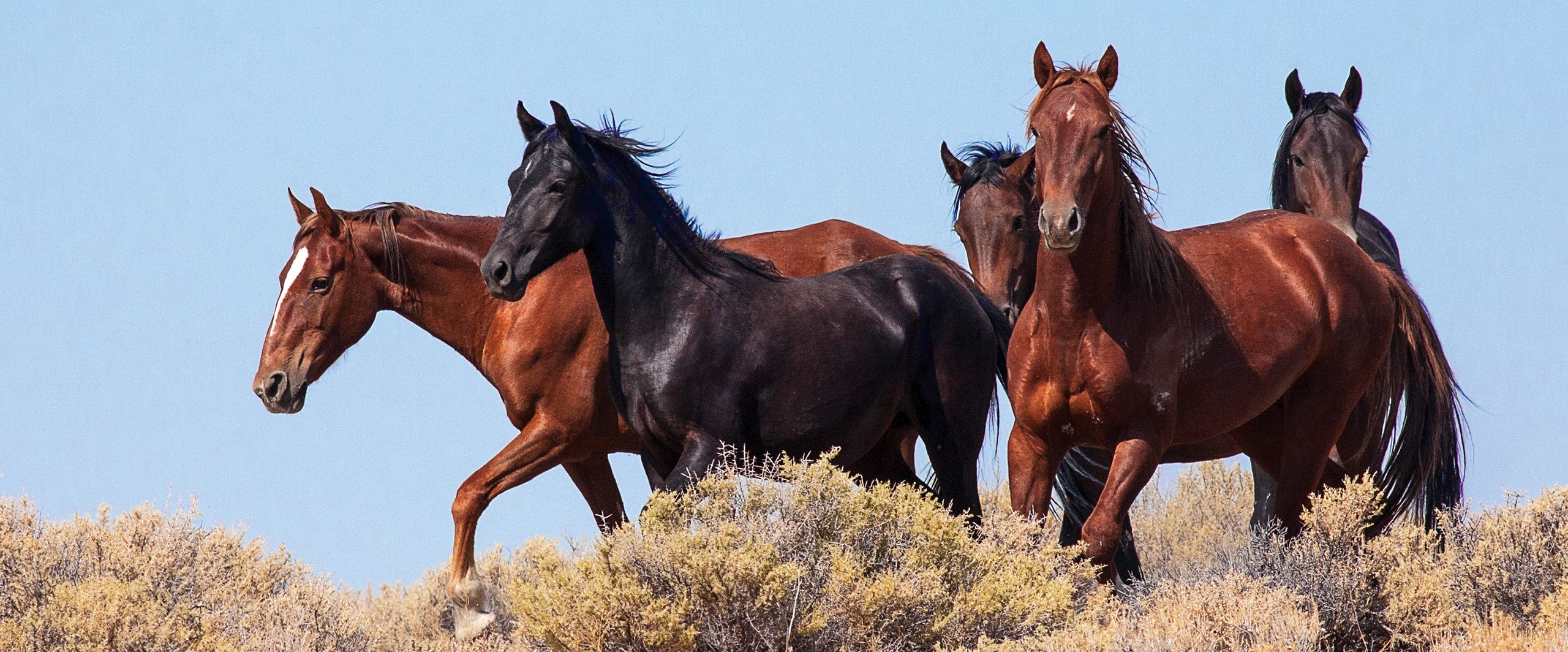
Wild horses and burros are charismatic and federally protected animals in many BLM-managed western rangelands. An extensive body of scientific papers and reports addresses these species. A 2013 National Academies of Sciences report summarized what was known at the time about topics including population size estimation and population dynamics, fertility control, genetics, and human dimensions. A 2019 interagency report examined ecological effects that overpopulated WHB can cause. There are more recent peer-reviewed publications in all those areas. The BLM WHB 2021 Strategic Research Plan summarized many WHB-related studies since 2005. The 2021 plan highlights research topics that would most benefit the BLM’s WHB management in the immediate future.
There are several ‘sub-pages’ for the WHB SPP page that you can access from the main drop-down list at left. So far, these are limited to the topics that come up the most in NEPA analyses. Subpages include links to current standard operating procedures, updated literature reviews for information and use in NEPA, and some key scientific citations.
All WHB-related research projects that would rely on BLM personnel, take place on BLM lands, use BLM-managed animals, or be BLM funded must be reviewed by the WHB research advisory team and approved by the WHB Program division chief. Information about WHB research for the public, and for researchers who want to submit WHB-related research proposals is at the BLM WHB program science and research web page, and in the sub-page called BLM-supported WHB Research.
BLM Contact: Paul Griffin, HQ-261 wild horse and burro research coordinator. Paul helps field, district, and state offices with information about WHB science, especially population growth suppression methods and genetics. He maintains a library of WHB-related papers, and can likely send you copies for internal BLM use.
The SPP page for the BLM Wild Horse and Burro program is organized by content, with eight sub-pages
This subpage has three tabs: 1) Literature review about fertility control methods and sex ratio manipulation, suitable for NEPA; 2) Fertility control standard operating procedures (SOPs); and 3) Key citations for several of the most common fertility control methods.
ESTIMATING HERD SIZE AND POPULATION MODELING
This subpage has two tabs: 1) Estimating herd sizes; and 2) Population modeling. Each tab has links to methods and citations.
ECOLOGY, ENVIRONMENT, AND CLIMATE CHANGE
This subpage has three tabs: 1) Literature review suitable for NEPA; 2) Key papers on WHB ecological effects; and 3) Assessment, Inventory, and Monitoring (AIM) and the WHB program
This subpage has three tabs: 1) A discussion about metapopulations; 2) Key citations on genetics; and 3) Past genetic monitoring reports for a number of HMAs.
This subpage includes key citations, and a literature review on the expected effects of gathers, handling, and removal that is suitable for NEPA.
This subpage refers to a couple key research papers about WHB private care placement.
HUMAN DIMENSIONS OF WHB MANAGEMENT
This subpage refers to a couple key research papers about human dimensions of WHB management.
This subpage has three tabs: 1) Explanation and templates for how researchers should prepare new research proposals to the BLM; 2) List of recently completed, BLM-approved WHB research and some of the associated research results; and 3) a listing of ongoing, BLM-approved WHB research projects.
If you have WHB-related material to submit to the SPP, please give it a title that starts with "WHB_" then the first author's last name, year of publication, and brief description, to allow for easier searching.