

BLM lands provide year-round habitat for a handful of upland bird species but provide seasonal and stopover habitat for hundreds of migratory birds. Resource Management Plans often identify some types of migratory birds as "priority species" and management efforts are often focused on these species. It is the responsibility of each biologist to know what priority species occur in their area and how best to meet their habitat needs.
Here is scientific information on some of the more high-profile migratory bird species managed by the BLM:
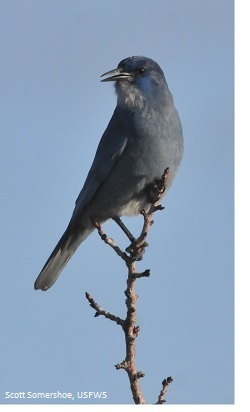 The Pinyon Jay is understudied and poorly known in most areas of its range. The BLM and its partners are concerned by the significant long-term population declines of the species, which are among the steepest declines of any bird in North America. Pinyon Jay populations are predicted to be reduced by an additional 50% from 2016 to 2035 (the so-called population “half-life”). Pinyon Jay has been identified as a Species of Greatest Conservation Need in State Wildlife Action Plans in most states across its range.
The Pinyon Jay Working Group strives to coordinate and collaborate among partners to address key information needs for the species across its range, including assessing habitat use and requirements, causes of population declines, and the impact of habitat management on the species.
Useful Links:
- Conservation Strategy for the Pinyon Jay
- Pinyon Jay Survey Protocols for Landscape Applications
- Guidance for Locating Pinyon Jay Nests and Confirming Breeding
- Recommendations for Avoiding Pinyon Jay Impacts in Nevada
- Guidelines to Minimize Impacts of Data-Gathering Activities on Pinyon Jays
Data and Analytical Tools for Birds:
- Avian Knowledge Network (AKN) - a partnership of people, institutions and government agencies supporting the conservation of birds and their habitats based on data, the adaptive management paradigm, and the best available science.
- Partners in Flight Species Assessment Database - This site provides a vulnerability assessment for all the landbird species in the U.S., Canada, and Mexico.
- Borderlands Avian Data Center – This site is a regional node of AKN and is a partnership of people and organizations working to improve bird and habitat conservation in the Southwestern U.S. and northern Mexico. Contains links to the “Planning for Landscape Management and Adaptation (PLuMA) Tool”, “Observations Map” and the “Phenology Tool."
- Breeding Bird Survey data - The North American Breeding Bird Survey (BBS) was initiated in 1966 and has since become one of the most systematically collected data sets for nationwide breeding birds.
- Christmas Bird Count data - the longest running Citizen Science Survey in the world. Each year bird enthusiasts record every bird they see and hear within a 15-mile diameter circle.
- eBird - a site where anyone can provide species observation data which are then compiled and managed by the Cornell Lab of Ornithology.
Plans and Partnerships:
- American Bird Conservancy - the only U.S.-based group with a major focus on bird habitat
 conservation throughout the entire Americas.
 - Bird Conservancy of the Rockies - a science- based bird conservation organization that conducts inventory, research, monitoring, and educational programs.
- Desert Thrasher Working Group – a group formed in 2010 to focus on LeConte’s Thrashers, Bendire’s Thrashers, and Loggerhead Shrikes – all exhibiting significant population declines based on Breeding Bird Surveys. The Desert Thrashers Working Group seeks to design, implement, and evaluate range-wide, collaborative research and monitoring efforts that will increase our knowledge and understanding of at-risk desert species in order to proactively inform conservation and management strategies. Includes “Thrasher Survey Protocol”, “Target Species Sighting Form”, “Thrasher Survey Form”, “Habitat Evaluation Form”, “Blank Area Plot Map”, and "Thrasher-ID Chart”.
- Great Basin Bird Observatory - provides upland habitat assessment protocol and data sheets. There are monitoring plans, and conservation plans that might give you great examples of program objectives or language to use in permitting or RMP revisions.
- Intermountain Bird Observatory - a non-profit research unit of Boise State University. Summaries of the data, as well as other publications from research conducted by IBO can be found on the website.
- Intermountain West Joint Venture - its mission is to conserve priority bird habitats through partnership-driven, science-based projects and programs.
- Klamath Bird Observatory - provides links to publications, current projects, and events. You can also find links to standardized methods for data gathering, banding workshops, and other training opportunities.
- North American Bird Conservation Initiative - brings together partners that work across state and country boundaries, and across taxonomic groups at a landscape scale to ensure that North American bird conservation is coordinated at a scale most relevant for the birds we work with.
- Partners in Flight - provides links to numerous bird related resources and outlines the role of PIF and its relationship to other bird conservation organizations and entities. It also acts as a clearing house for land bird related websites and publications.
- Raptor Research Foundation - provides a plethora of raptor related information- from aid in raptor ID to a clearinghouse of raptor related research and publications.
- U.S Fish and Wildlife Service Migratory Birds Website - contains great information about proposed rulemaking related to birds, lead shot, hunting, surveys, policies, and permits. There are links to grant programs; citizen science opportunities; educational resources; and suggested Conservation Measures.
Joint Ventures:
Migratory Bird Joint Ventures: Umbrella site for all 24 Joint Ventures in United States with map of all Joint Ventures. Established as a result of the North American Waterfowl Management Plan to create cooperative, regional partnerships to conserve habitat to benefit birds, other wildlife and people. The primary joint ventures that overlap with BLM in the western United States are:
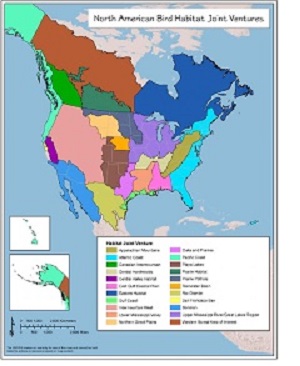 Intermountain West Joint Venture: Includes much of the western United States with portions of Washington, Oregon, eastern California, most of Nevada, north portion of Arizona, New Mexico, Utah, part of Colorado, most of Wyoming, and part of Montana. (BLM Leadership on the Board)
Central Valley Joint Venture: Central California partnership. (BLM on Board)
Northern Great Plains Joint Venture: Central to southeastern Montana. (BLM on Management Board & Technical Committee) ** Important area for Grassland bird breeding**
Pacific Birds Habitat Joint Venture: Western portions of Washington and Oregon with focus on Oak and Prairie Conservation, Hawai’i and California coastal wetlands.
Prairie Pothole Joint Venture: North-central to north-eastern Montana and North Dakota. To implement Conservation programs to sustain waterfowl, shorebirds, other waterbirds, and prairie landbirds. (BLM Board position vacant and BLM represented on Technical Committee).
Sonoran Joint Venture: Southern California and southern portion of Arizona into Mexico in Arid Borderlands, Californian Coasts and Mountains, Mexican Highlands, and Pacific Lowlands. BLM on Board and participates in Science Working Group).
Playa Lakes Joint Venture: Eastern Colorado and New Mexico, Western portions of Texas, Oklahoma, Kansas, and Nebraska. Shortgrass and Central mixed grass prairie. (BLM on the Board)
Bird Migration:
Audubon Bird Migration Explorer ---or--- BirdCast: real-time migration information
 Useful Bird Related Apps:
Smartphone Field Guides: Conduct a search in App Store dependent upon which smartphone you use. To be used only as reference.
Audubon Birds - Regional and North America
Sibley eGuide - Birds of North America
iBird - There is a lite, pro, and plus version. Lite is free and cost goes up from there based on which version and how large a region you want.
Other Birds: There are countless migratory bird species residing on BLM lands. It is up to the wildlife biologist to ensure their ecological needs are met and secure. We should strive to always use the best scientific information available to help us meet those needs.
Don't forget to check out:
- Natural Heritage Programs
- T&E Species
- BLM Research Tab at the top of the Wildlife page.
You can also browse the HQ230 SharePoint folder: Migratory Birds {Under Construction}