
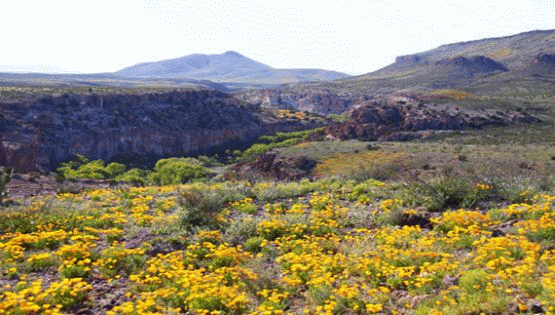
The Madrean Archipelago REA was initiated in September 2012. It has been completed and peer reviewed and is now available to the public. The Memos and Reports section provides access to the REA data for this ecoregion.
The Madrean Archipelago ecoregion is located in southeastern Arizona and southwestern New Mexico. It is characterized by isolated forested mountain ranges that are surrounded by a virtual sea of intervening deserts and grasslands; thus the mountains in this area are also known as the “Sky Islands". The ecoregion is located within the Madrean Pine –Oak Woodlands, a globally significant biodiversity hot spot, and harbors the highest diversity of mammals, birds, bees, ants of anywhere in the continuous United States.
Large elevation gradients (ranging from 600m at the base to 3,000m at the summits) and topographic roughness contribute to the high diversity of species and biotic communities. The ecoregion is located at the intersection of the temperate zone to the north and sub--- tropics to the south where several major desert and forest biotic influences converge, including the Rocky Mountains, Sierra Madre, the piedmont and plains of the western Sierra Madre, Sonoran Desert, and Chihuahuan Desert.
Warm temperatures are a defining characteristic of the region and during dry summer months can climb above 100 degrees F in lower elevations. Annually, the region receives around 12 inches of rain in valley bottoms and up to 30 inches at mountain tops. Precipitation occurs primarily during the summer monsoon and the winter season.
The Madrean Archipelago is home to numerous endemic species such as the Mt Graham red squirrel and Atascosa gemmed grasshopper, species at the edges of their ranges such as the elegant trogon and ocelot, and neotropical species such as coati and coral bean. Biotic communities include montane coniferous forests, oak---pine woodlands, tropical deciduous forest, oak savanna, short-grass prairie, subtropical thornscrub, and subtropical desert. The ecoregion also contains critical riparian and wetland habitats (cienegas, springs) that encompass a very small portion of the land areas but are keystone ecosystems in this arid environment.

A series of three development forums were held to work with land managers in the Madrean Archipelago region. The questions resulting from these information sessions were combined with a literature review and other sources of management issues in the ecoregion in order to focus the assessment, identify key drivers for conservation elements, and identify additional assessment work that would be relevant to natural resource managers in the Madrean Archipelago.
Initial questions, a summary of the issues identified, and results of the literature search and development forums are covered more fully in the Pre-Assessment Report.
Conservation elements are resources of conservation concern within an ecoregion. This REA will assess the current status and forecast the future condition of these conservation elements:
-
Communities: ecological systems, which represent characteristic vegetation assemblages or “biomes “occurring within the ecoregion (e.g. desert grasslands, oak woodlands, lowland riparian areas);
-
Landscape Species/Guilds: terrestrial and aquatic species specific or collections of species, which represent specific additional conservation targets/needs beyond communities (e.g. pronghorn, raptors);
A full list and description of conservation elements is included in the Pre-Assessment Report
Change agents are disturbances on the landscape that can influence ecosystem health. They can have natural causes, such as wildfire; human causes, such as energy development; or result from the interaction of both, such as climate change. A key purpose of this REA is to understand the influences of significant, widespread change agents on the natural resources (represented by the conservation elements discussed above) of the Madrean Archipelago.
This REA will examine the potential effects of the following change agents. A more complete discussion of change agents will be presented in the Pre-Assessment Report.
Change agents to be addressed in Madrean Archipelago REA are:
-
Climate Change
-
Development: Industrial, Urban, and Agricultural
-
Invasive Species: Terrestrial and Aquatic
-
Wildland Fire
Geospatial data, maps, and models used in and produced by the Madrean Archipelago REA will be made available to the public upon final completion the assessment. In some instances, data may be released in phases for an REA to expedite public access to particular data sets. To learn more about REA data products and determine which REAs have available data, go to the REA Data Portal.
For each REA, there is a series of memos, which are iterative documents used to plan work and build up to the final reports for each phase of the assessment. Memos document the major tasks and decision points made during the assessments and provide pertinent background information necessary to understand the justification and methods used during the assessment. In addition, we will provide brochures to summarize the work compiled for each task in a short, easy to understand format and slide presentations from update webinars will also be provided for each task. As memos, reports, and other outreach materials are completed, they can be downloaded through the table below.